
The heart is a very important part of the human body. If we consider its duty, it comes at number 1 in terms of importance. The rest of the body’s organs are also very important in their own place, but the importance belongs to the human heart, and no one else.
The brain is also very important and in terms of importance, it probably comes at number 2. Consider that if someone tries to hit you on the head with a stick, you immediately put your hand forward. Although the hand is also yours, but even if you don’t want to, you think that the head is more important, so you save the head and stop the blow of the stick on the hand.
Now you see why this organ is so important, even if your brain, eyes or ears are not working properly, you can still live, but if your heart stops working, you die immediately. Therefore, the heart is of the utmost importance in the human body and it is also very important to protect it.
If the heart is not completely healthy, you cannot complete the routine of life properly. Neither can you walk fast nor can you perform every task as desired. The brain and the rest of the body are also indebted to the heart because if the heart does not provide them with oxygen-rich blood, they cannot continue their work.
Heart Shape.
The human heart is a pump. Its length is equal to the human fist, and its thickness is equal to the human fist. Just as the human body is made up of cells, so it is also made up of millions of cells.
Like a pump, it also has valves that close and open. There are pipes for blood to come in and go out. The function of the heart is to deliver blood to the whole body because blood contains oxygen and whatever food we eat has its power or effect, so the blood pumped by the heart reaches the whole body and provides oxygen and nourishment to every cell of the body.
The heart’s own cells also get nourishment and oxygen from this blood. As the heart keeps beating, it also keeps itself alive and keeps the rest of the body alive. As soon as the heart stops, all the other parts of the body also stop working.
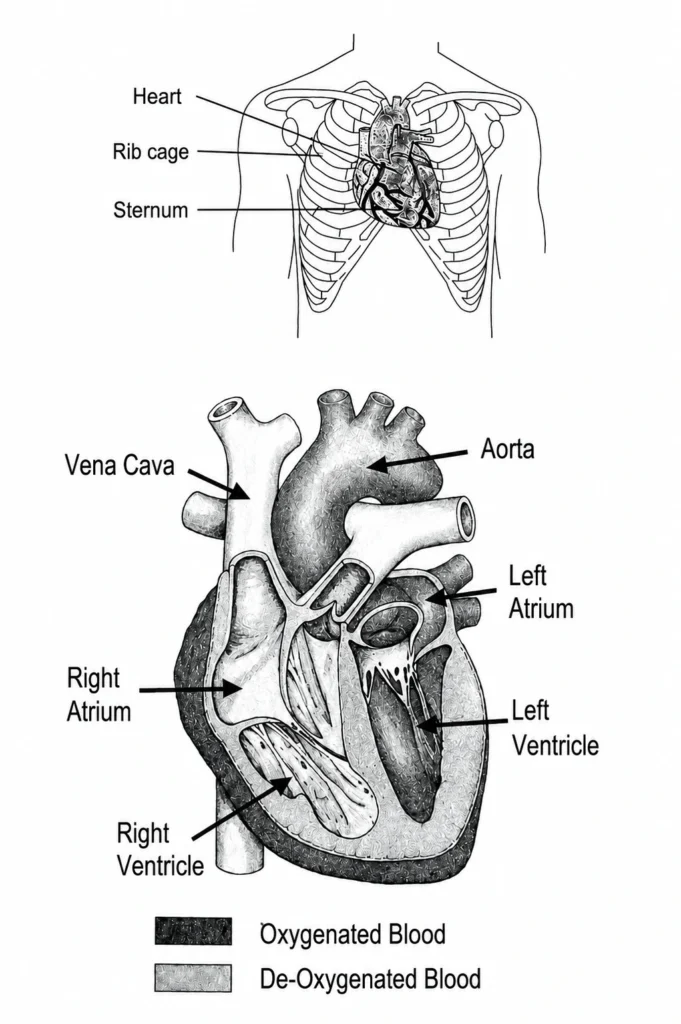
Heart and Body Veins.
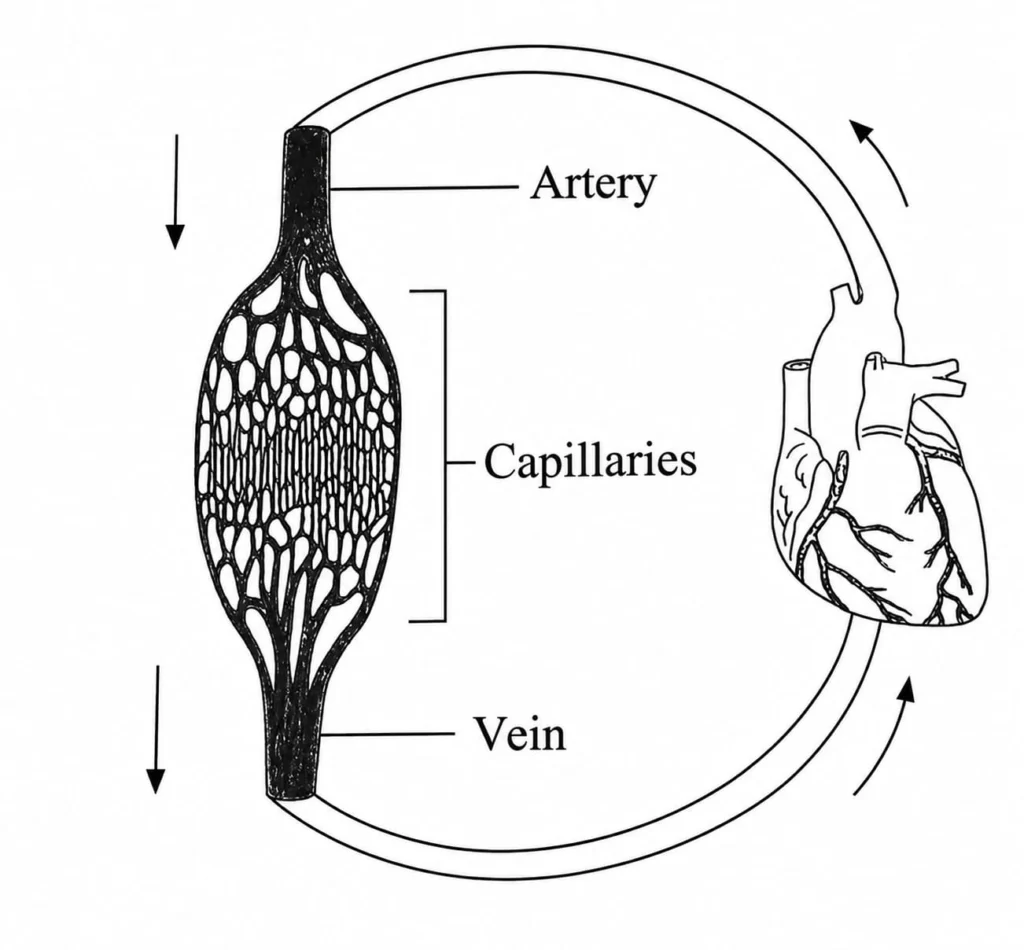
Blood leaves the human heart and goes throughout the body through veins. And then it returns to the heart through veins. So in English, we call all of them veins.
Interestingly, doctors and scientists have divided them into four different parts and their names are also different.
Types of Blood Vessels.
- ARTERIES
- VEINS
- CAPILLARIES
- COLLATERALS
The total length of these veins is 60,000 miles or about one hundred thousand kilometers. Now imagine how hard this heart works to pump blood through one hundred thousand kilometers of veins.
Arteries are the veins that carry blood from the heart to every part of the body. They have tiny branches called capillaries. They are very thin and have very thin walls. Oxygen-laden blood is delivered to every cell in the body through them, and carbon dioxide and wastes are collected back from there.
This blood returns to the heart through veins through small venules.
Coronary Arteries.
The human heart also receives its own muscle, called the myocardium, from arteries. These arteries are called coronary arteries. Because these arteries are located above the heart like a crown or corona, they are called coronary arteries.
These arteries supply blood to all parts of the heart from both sides. Normally, they do not communicate with each other, but nature has made such an arrangement that if one artery becomes blocked, a little blood can flow through the other artery.
Collateral Vessels.
The small vessels through which two coronary arteries can connect are called collaterals.
These coronary arteries can be opened with doctor-prescribed exercises and certain medications, which can reduce angina and even prevent heart attacks.
The Difference Between the Heart of a Man and a Woman.
Generally, a woman’s body is smaller than a man’s. That is, her build is smaller and lighter than a man’s, so her heart is also slightly smaller in size than a man’s. And its heart rate is slightly higher.
It is generally said that women are less likely to develop heart disease until they reach menopause. But there have been some cases where women between the ages of 20 and 40 have developed heart disease due to some hereditary or congenital causes.
Secondly, women who are obese, have high blood pressure or diabetes can develop heart disease even at a young age. Therefore, women should also protect their hearts from the beginning and should not be careless.
Symptoms in Men.
Men experience chest pain and heaviness when they have a heart problem.
Symptoms in Women.
Women experience a burning sensation in the chest and abdomen, something that is generally considered digestive, and angina is not properly diagnosed.
Often, carelessness is taken. However, by getting checked by a doctor, it is immediately known whether it is angina or a digestive disorder.
This is because women have a certain type of endurance that is higher than that of men, so it is more difficult to detect in women than in men.
Some important facts about the heart.
- In this world, approximately 15 million people die every year due to heart diseases, two-thirds of whom are under the age of 70, meaning they are not yet of medical age to die.
- Only 30 percent of those who die from heart attacks are those who have their first heart attack in their lives, and they pass away, meaning they don’t get a chance to get treatment or think about it.
- The life span of a smoker is 10 to 15 years shorter than that of an average person. This has been scientifically proven. With every cigarette, human life is shortened by 15 minutes.
- Heart disease is more common in women after the age of 45.
- It is very interesting and meaningful that animals do not have heart attacks, while humans do.